
Here we share hand-picked stories highlighting the hidden in science, health, technology, history, and culture. Click on the title to read the article!
Her Code Got Humans on the Moon – And Invented Software Itself

Margaret Hamilton standing next to listings of the software she and her MIT team produced for the Apollo project (1969). Original photo restored by Adam Cuerdon. Wikimedia Commons. Public Domain.
Margaret Hamilton was an early tech pioneer, one of the rare female programmers working at the MIT Instrumentation Lab in the 1960s. Margaret created software for the world’s first portable computer: the NASA Apollo Program Command Module Computer. This was during a time when hardware was king, and “software” itself was barely a concept. Hamilton and her colleagues laid the groundwork for core ideas in computer programming, while developing the onboard flight navigation software for the Apollo spacecrafts. Their programs enabled Apollo 8 to orbit the moon and Apollo 11 to land men on the moon. If you’ve flown in an airplane, you were in the hands of a great-great grandchild of Hamilton’s software. This article highlights the joys and challenges Margaret Hamilton encountered working at the forefront of science creating technology that ushered in the modern computer age. – Kim Paul
My Mother Was Part of The Manhattan Project
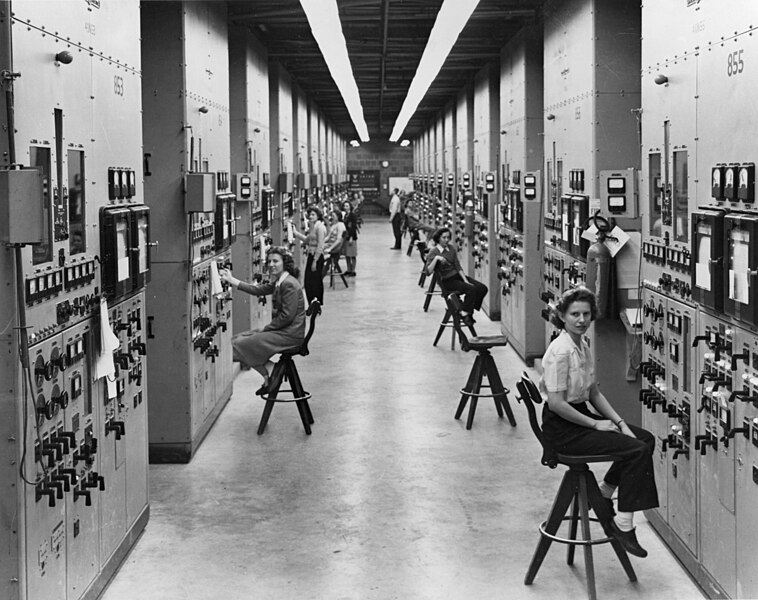
With the release of the movie Oppenheimer in July 2023, J. Robert Oppenheimer has reclaimed his status as a household name, but this time, with more clarity around the horrendous trials he faced during the Manhattan Project and after. The 2023 film and its inspiration, the biography, American Prometheus (2005), center on Oppenheimer. While these works beautifully explain his perspective, intellectuality, and ideology, they cannot highlight every individual that helped on the project.
One such person that worked on the Manhattan Project was the mother of author Taylor-Grace, who explains her mother’s position as a Calutron Girl, who operated the mass spectrometers that isolated the Uranium-235 isotope. U-235 was needed for the uranium atomic bomb. Many of these women’s stories have remained hidden despite them now suffering from diseases of radiation exposure as a result of their work in the 1940s. This blog post highlights some of the many people who made vital contributions to STEM, but have been overlooked, often due to their identities. The Calutron Girls may not be who you picture as traditional workers on the Manhattan Project, but they made significant contributions and ultimately the Project could not have succeeded without them. – Katie Barfield
Discovery of 2-Million-Year-Old DNA in Greenland: Reveals New Details about Ancient Life

Photo by Jeremy Harbeck of NASA. Public Domain.
This PBS article is an interview between journalist William Brangham and Professor Eske Willerslev, an evolutionary geneticist at the University of Copenhagen’s GLOBE Institute. The discussion revolves around a groundbreaking discovery: 2 million-year-old DNA was found in Greenland, which indicated that Greenland was not always an icy tundra. Willerslev delves into the intricate process of extracting and identifying this ancient DNA from the soil. The article also sheds light on the stark contrast between the past and present environment of Northern Greenland: once it was a thriving habitat, and now is transformed into an arctic tundra. Read the article to uncover more about what this discovery means for the current climate change scenario! – Halee Lott

Photo taken by European Space Agency. Public Domain.
The Great Green Wall is an initiative started by the African Union in 2007. Its goal was to fight desertification, which is the degradation of fertile land into desert, on the continent of Africa. A lack of upkeep and climate change have led to the erosion and loss of farmable land. This project was started with an audacious goal: to plant a 7000-kilometer wall of trees stretching from the Atlantic Ocean to the Red Sea. Now, the project has morphed into an effort to set up community gardens, improve soil, and increase forest conservation. However, these initiatives are being undermined due to insufficient funding. More information on the Great Green Wall can be found here.
To read more about general scientific unity in Africa, this article does a fascinating, comprehensive survey of African Union scientific initiatives, since its founding 60 years ago. – Noelle Shorter
Gene Therapy Brings Hearing to Kids With Congenital Deafness

What if I told you there is a new alternative to hearing aids for children with congenital deafness? Yes, that’s right. All thanks to an experimental gene therapy, new research conducted in China gave five children born deaf the ability to hear. The therapy involves using a hollowed-out virus loaded with a healthy version of the gene responsible for producing otoferlin, a protein needed for the transmission of sound signals. Injection of the Otoferlin-loaded virus into the inner ears of these children resulted in hearing recovery within just six months.
Although these results are groundbreaking, they also pose an ethical dilemma. The
Deaf Community is a very close-knit group, who communicate through sign language and even have their own schools for deaf children. What do these hearing children do now? Do they switch schools and forget a language they learned? Would they lack communication skills if they have a sibling or parent with hearing trouble? The answers to these questions remain a mystery for now, but it’s important they are addressed by both the Deaf community and the medical community in the future. – Meghan Werner
The Quest To Wear Nature’s True Colors

Gone are the days when we mixed dyes, water, and even urine in a cauldron-like pot to dye clothes the variety of colors we know of today. For the last 130-ish years, we have been using synthetic dyes that are chemically manufactured from petroleum. The issue with these synthetic dyes is that while they give us the vibrant colors we love, they are being dumped into waterways, and the overall dying process also harms the environment. More recently, there have been a few companies, like Colorifix, that have shifted back to the old alchemy, an archaic way of dying clothes from botanical and recycled sources, albeit with a high-tech twist.
Colorifix is a startup company based in the UK that uses bacteria to dye clothes without the use of harmful chemicals. The Colorifix bacteria are genetically-engineered with DNA sequences from various biological organisms that code for color compounds. In the article, Colorifix’s CEO is interviewed and discusses their dying process and future ideas for patenting their technology. Colorifix hopes their technology will be adopted by the fashion industry, as it could ultimately revolutionize the space.
Check out this article for fun visuals of Coloifix’s bacteria and resulting dye colors! – Lillian Mergen

Wait – adults can struggle with ADHD? While ADHD is commonly portrayed in children, many people forget that this disorder does not self-cure as body and brain develops. This blog highlights two individuals, David Martin and Megan Rafuse, who were not treated for their ADHD until adulthood. After their diagnoses, prescribed medication helped them complete tasks more efficiently and changed their lives for the better. Today, use of ADHD medications has reached an all-time high, rising from 1 per 1000 individuals in 2004 to 16.5 per 1000 individuals in 2022.
Physicians are concerned that not all individuals obtaining a prescription truly have ADHD. People seeking prescriptions for ADHD medications for extra energy and focus may pay a few hundred dollars to go to a private clinic, and/or exaggerate symptoms to gain access. Although ADHD medications are considered safe, they are not entirely risk-free, especially if misused. Sleep deprivation, loss of appetite and in severe cases, heart attacks or strokes are all risks associated with ADHD medications. So while these drugs have changed the lives of many, the risks they impose make it important that these medications be reserved for people officially diagnosed with ADHD. – Nicholas Magnin
Lost Spirits Distillery: Innovating Dignified Spirits from Scratch

Bryan Davis, an artist, entrepreneur, and self-taught chemist, became the first person to recreate the chemical signature of various 15-20-year-old spirits in just a few days! His innovative breakthrough created a product for people to enjoy and immerse themselves in a unique infatuation. An oligopoly of significant liquor corporations has seemingly controlled the spirit industry after the prohibition era. Today, Lost Spirits Distillery is a newer business trying to make its mark in a highly developed industry by changing how alcohol is manufactured and distributed. This video provides insight into the man who made it happen and how he founded Lost Spirits Distillery. – JC Ferguson
 The Mary Bruce Project