By Alexys King
It’s January 22nd, 1929. Mrs. Alice Byrd had just
given birth to a baby boy four days prior. Alice should have been the picture
of a perfect new mom: exhausted, but happy and content with her life. Instead,
she had suffered severe third-degree burns, and her skin had sloughed off, causing
permanent damage. Alice received these injuries from a Burdick cabinet, a sweat
cabinet sometimes referred to as a radiation cabinet or baking cabinet. The
Burdick cabinet was designed to help patients “sweat out” electrolyte
or chemical imbalances. Dr. James F. Miller, and his wife, nurse superintendent
Jean F. Miller, owned and operated the cabinet.

Given Alice’s condition, Dr. Bingham, Alice’s primary physician, warned Frank
Byrd, Alice’s husband, that Alice could have a series of convulsions following
the delivery. Dr. Bingham advised that if Alice were to have convulsions, Frank
should rush her to the hospital immediately to have them “sweated out1.”
According to Alice’s court testimony, Dr. Bingham was the only doctor that had
treated her before she received the sweat cabinet treatment1.
“Walter Reed Physiotherapy Story.” 1920 or 1921 Burdick Cabinet “Radio-Vitant ray” therapy. National Photo Company Collection Glass Negative.
On January 22nd, Alice developed convulsions, so Frank rushed her to the
hospital to be treated in the sweat cabinet. Dr. Bingham called ahead to the hospital,
asking for Dr. Miller, but was informed that he was out of town. Dr. Bingham told the hospital that
the nurses should prepare a sweat cabinet and be prepared to receive Alice’s ambulance
when it arrived. When Alice arrived at the hospital,
she was unconscious and having convulsions about every 5 minutes.
Though Dr. Miller was out of town, his wife Jean Miller, was available
to receive and prepare Alice for her sweat cabinet treatment. Jean removed
Alice clothes and replaced them with a hospital gown, vest, and abdominal
binder. The vest and binder were to help Alice maintain her posture while in the sweat cabinet.
Alice’s hands and feet were tied together to eliminate the possibility of injury
via broken lightbulbs inside the cabinet. Alice was administered a sedative and then placed into the cabinet, and her treatment began.
At this point, the testimonies diverged. Jean and the other
nurses stated that Dr. Bingham was present when Alice was given the sedative and
placed in the cabinet. There were other witnesses present that also testified
and agreed with Jean and the nurses. Frank Byrd testified that he couldn’t remember,
but later stated, “…I think I saw my wife in the sweat cabinet before
Dr. Bingham got there1.” A neighbor of the Byrds, Mrs. Davis
Bright, arrived at the hospital with Alice and testified that Dr. Bingham was
present when Jean Miller administered the sedative and when Alice was placed in the sweat cabinet.
Jean and the other nurses discovered severe third and fourth-degree burns on Alice’s
legs…
No one disputed that when Alice was removed from the sweat cabinet, Jean
and the other nurses discovered severe third and fourth-degree burns on Alice’s
legs, which she had received from the electric lights inside the cabinet.
The Byrds sued the hospital. According to an outside physician, “… if
plaintiff [Alice] had been properly prepared, ‘covered with Turkish towels, you
couldn’t burn her.'”1 The court determined that Dr. James F.
Miller, Jean’s husband, was at fault for Alice’s injuries, even though he was
not present at the time of the incident. Based on the jury’s evaluation, the
Byrd family received $29,975 in damages, based on the lasting injuries she
received1.




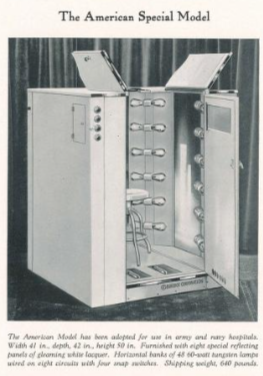

Burdick Ultraviolet Lamps. 1930s Burdick Physical Therapy Equipment Catalog. Jeff Behary; Internet Archive.
Byrd versus Marion General Hospital is a landmark case for nurses and
physicians in North Carolina. The verdict of this case prompted questions about
what duty a nurse owes a patient and who is liable when something happens to the
patient. In theory, nurses don’t routinely make patient care decisions; instead,
they are considered to act only under a physician’s orders. Therefore, nurses
are legally considered hospital agents. In the case of Bryd v. Marion General
Hospital, the liability was placed on behalf of Jean Miller onto her physician
husband, Dr. James F. Miller, because they privately owned the sweat cabinet.
There are apparent structural power differences between nurses and
physicians: the nurses must obey the physician’s orders in charge of a
patient’s care. This principle holds under nearly all circumstances, except when a
physician’s order is so negligent that a reasonable nurse could anticipate that
substantial injury or harm would come to the patient. The Nursing Practice Act,
ratified after the Byrd v. Marion General Hospital verdict, states that the physician will be held “solely responsible for the diagnosis and treatment of his patient1.” Thus, due to their lack of expertise in diagnosis and treatment, nurses acting under physicians’ orders carry no responsibility for patient harm1. The Nursing Practice Act protected nurses from prosecution due to medical error, when acting under a physician’s orders2.

These protections ended when the North Carolina Supreme Court overturned the
long-standing Nursing Practice Act on August 19th, 2022. The reversal of the Byrd v. Marion General Hospital precedent stemmed from the case of a three-year-old child from North Carolina
who suffered permanent brain damage during a heart procedure. The three Supreme
Court judges that voted to repeal the Nursing Practice Act stated that
“…due to the evolution of the medical profession’s recognition of the
increased specialization and independence of nurses…we determine that it is timely and appropriate to overrule Byrd…3. The fact that the North
Carolina Supreme Court overturned the Nursing Practice Act has radically
changed the legal landscape for nurses in the state, and their future is unknown. Many
nurses have decided to seek new employment elsewhere, while others have chosen
to be proactive and fight for their ability to do the work they were called to do
with adequate legal protections4.
The North Carolina Supreme Court’s decision will have a lasting impact. A lack of nurses during the current healthcare profession shortage will only exacerbate existing problems with patient care, support, and medical care in general. Doctors will begin to leave, patients will stop seeking care, and the entire North Carolina healthcare system will be undermined. Nurses are one of the pillars of medicine. They don’t just offer care and support; they provide irreplaceable services advocating for patients and their families.
I believe overturning the Nursing Practice Act was a radical move on the North Carolina Supreme Court’s part. There were other options that the Supreme Court could have taken in the face of the evolving healthcare profession. Insurance companies and employers can offer liability insurance as a workplace incentive or offer discounts on out-of-pocket liability insurance that nurses might need to purchase. Physicans are already responsible for purchasing their own malpractice insurance, should nurses be placed under standard when it comes to liability? Another path the Supreme Court could have taken was to maintain the law and put amendments in place that ensure that nurses can be held liable for actions not directed by the physician. Despite the recent efforts of the North Carolina Supreme Court, nursing is a hard enough profession without considering taking liability for every mistake made on the job. By changing the law that governs how nurses are able to follow physicians’ orders, are more lives being put at risk or is the future of nursing in North Carolina at risk due to nurses having to watch their every move while on the job?
Sources
- Brogden J. Byrd V. Hospital. Legal research tools from Casetext. https://casetext.com/case/byrd-v-hospital/. Published March 1, 1932. Accessed April 21, 2023.
- Chamlou N. What the NC Supreme Court ruling means for nurses’ civil liability. NurseJournal. https://nursejournal.org/articles/nc-nurses-sued-for-following-doctors-orders/. Published September 15, 2022. Accessed April 21, 2023.
- Schreiber E. North Carolina Supreme Court rules that nurses can be help criminally liable for medical errors. World Socialist Web Site. https://www.wsws.org/en/articles/2022/09/13/vlcl-s13.html Published September 13, 2022. Accessed April 21, 2023.
- Falcone S. Nurses Can Be Sued for Following Doctor’s Orders, NC Court Rules. Nurse.org. https://nurse.org/articles/north-carolina-overturns-nurse-ruling/#:~:text=On%20Friday%2C%20August%2019%2C%202022,evolved%2C%20the%20decision%20was%20necessary. Published September 2, 2022. Accessed April 21, 2023.
Image Sources
- Burdick Cabinet Physiotherapy at Walter Reed. Radio-Vitant: 1920. Shorpy. https://www.shorpy.com/node/4138. August 4, 2008. Accessed November 28, 2023
- Chapter V. Electric Light Bath Cabinets, p. 56-62. In Burdick Light Therapy Equipment. (1931) Burdick Corporation, Milton WI, USA. Internet Archive. https://archive.org/details/Burdick/page/n29/mode/2up (Accessed on 11/28/2023).
- North Carolina State Supreme Court, Modified from original by Alexisrael, https://commons.wikimedia.org/wiki/File:NC_Supreme_Court.JPG. Creative Commons CC BY-SA 3.0.
- @NCNursesAssociation. H149- which includes the #SAVEact language in its entirety- just passed Senate Rules. Next step: a vote on the Senate Floor. Full Practice Authority for #APRNs is on the move in North Carolina!!. Posted May 31, 2022. Accessed November 7, 2023. https://twitter.com/NCNA/status/1531678030975868929

 The Mary Bruce Project
